
How to Choose the Right Compliance Framework for Your Organization
Compliance frameworks are not one-size-fits-all. The right framework for a healthcare MSP serving regional clinics looks nothing like the right framework for a SaaS company pursuing enterprise contracts. And for organizations that operate across multiple sectors — or serve clients in regulated industries — the question of "which framework" often becomes "which frameworks, in what order, and how do we avoid duplicating effort across all of them."
This guide is designed to help MSPs, MSSPs, and compliance-driven organizations move from confusion to a clear, defensible framework adoption strategy. We'll cover what distinguishes major frameworks from one another, how to match them to your actual regulatory drivers, and how to think about overlapping requirements so your compliance effort scales rather than compounds.
What a compliance framework actually is
A compliance framework is a structured set of security and operational requirements designed to reduce risk in a specific context. Some frameworks are legally mandated — HIPAA applies to any organization that handles protected health information. Others are market-driven — SOC 2 has no legal force, but enterprise buyers increasingly require it before signing contracts.
Understanding this distinction matters enormously at the selection stage. Mandatory frameworks represent legal obligations with real enforcement consequences. Market-driven frameworks represent competitive and reputational leverage. Both are worth pursuing — but they require different urgency and resourcing.
Key distinction
Before evaluating which framework to pursue, determine whether you are choosing based on legal obligation, client or partner requirements, or proactive risk management. Each driver changes the priority order significantly.
A step-by-step framework selection process
Most organizations default to the framework they hear about most often — typically SOC 2 or HIPAA — without first mapping their actual regulatory environment. The steps below create a defensible, systematic selection approach.
- Identify your regulatory and industry obligations: Start with what is legally non-negotiable. Does your organization process protected health information? HIPAA applies. Do you handle payment card data? PCI DSS applies. Do you process data of EU residents? GDPR applies regardless of where your organization is based. Do you hold federal contracts? CMMC may be required. These are non-discretionary starting points.
- Map your client and partner requirements: Many organizations face compliance pressure not from regulators, but from the organizations they do business with. Enterprise buyers increasingly require SOC 2 reports before signing vendor agreements. Government clients may require NIST or CMMC alignment. Healthcare systems often require HIPAA BAAs and evidence of security controls. Survey your active client base and your target market segment to identify which frameworks are showing up in procurement and contracting conversations.
- Assess your organization's data environment: The nature of the data you handle and the environments you operate in should drive framework selection. Cloud-native organizations benefit from ISO 27001 and NIST CSF's technology-agnostic structure. Financial services firms face FTC Safeguards obligations. Organizations processing cardholder data have PCI DSS regardless of size. Document your data flows and classify them before committing to a framework.
- Evaluate control overlap before selecting multiple frameworks: If your analysis identifies more than one applicable framework — which is common — do not treat each framework as a separate compliance project. Map controls across frameworks before beginning implementation. A single control implemented correctly can satisfy requirements across HIPAA, NIST CSF, and SOC 2 simultaneously. This is where a platform with cross-framework control mapping creates outsized value for organizations managing multiple obligations.
- Sequence adoption based on risk and deadline:Not every framework needs to be implemented at once. Prioritize based on: legal deadline (HIPAA 2026 NPRM changes take effect this year), active enforcement risk, contract requirements with near-term renewals, and implementation complexity. Build a phased adoption roadmap rather than attempting full multi-framework compliance simultaneously.
The major frameworks — who they apply to and why
Below is a practical breakdown of the eight frameworks most commonly encountered by MSPs, MSSPs, and regulated organizations. This is not a legal interpretation — it is an operational orientation to help you identify which frameworks deserve your immediate attention.
HIPAA / HIPAA 2026: Healthcare & covered entities
Applies to any organization handling protected health information (PHI). The 2026 NPRM eliminates the "addressable" category — every safeguard becomes mandatory. MSPs serving healthcare clients are typically Business Associates and carry direct obligations.
SOC 2: Technology & service providers
Market-driven, not legally mandated. Demonstrates security, availability, and confidentiality controls to enterprise buyers. Type I is point-in-time; Type II covers a period of time and carries more weight. Increasingly required in B2B SaaS and IT services contracts.
NIST CSF 2.0: Broad industry applicability
A voluntary framework by the National Institute of Standards and Technology, but increasingly referenced in federal contracts and as a baseline for security programs. Version 2.0 adds Governance as a core function. Excellent as a foundational structure when other frameworks apply on top.
ISO 27001:2022: Global enterprise & international markets
The internationally recognized standard for information security management systems (ISMS). Essential for organizations pursuing international enterprise contracts or demonstrating security maturity to global partners. Certification requires an accredited third-party audit.
CMMC 2.0: Defense industrial base
Required for organizations seeking or holding DoD contracts that involve controlled unclassified information (CUI). Level 1 is self-assessed; Level 2 requires third-party assessment and aligns closely with NIST SP 800-171. Non-compliance disqualifies organizations from contract eligibility.
PCI DSS 4.0.1: Any org processing payment cards
Mandated by card brands (Visa, Mastercard, etc.) for any organization that stores, processes, or transmits cardholder data. Version 4.0.1 introduces more flexibility in how controls are implemented while increasing focus on targeted risk analysis.
GDPR :Organizations processing EU resident data
Applies regardless of where the organization is located if it processes data of individuals in the EU. Heavy focus on data subject rights, consent, data minimization, and breach notification. Non-compliance fines can reach 4% of global annual revenue.
FTC Safeguards: Financial services firms
The FTC's updated Safeguards Rule applies to non-bank financial institutions — including auto dealers, mortgage brokers, and financial advisors. The 2023 update significantly expanded technical requirements and introduced a formal incident response obligation.
"The organizations that struggle most with compliance are not those with too few controls — they are those who implemented controls without first understanding which frameworks actually apply to them."
Understanding framework overlap — and why it matters
One of the most costly mistakes in compliance planning is treating each framework as a completely separate body of work. In reality, major frameworks share significant structural overlap because they are all addressing the same underlying risk categories: access control, incident response, asset management, policy governance, and data protection.
The table below illustrates how a selection of core security domains appear across multiple frameworks. A control implemented for one framework frequently satisfies the same requirement in another — but only if your compliance system is designed to capture and map that relationship.
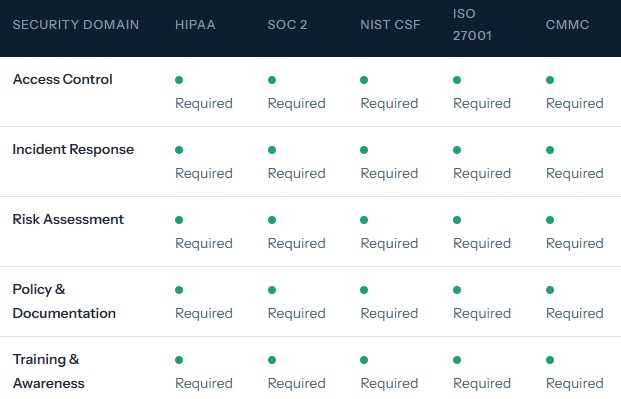
When access control is implemented correctly for HIPAA, the same implementation satisfies comparable requirements in NIST CSF, SOC 2, and CMMC. The difference is in documentation, evidence mapping, and audit trail — not the underlying technical control. A platform that maps a single control across all applicable frameworks eliminates the duplication that makes multi-framework compliance feel impossible.
For MSPs: managing frameworks across a client portfolio
MSPs face a layer of complexity that standalone organizations don't: they are often subject to compliance obligations themselves, while simultaneously needing to manage compliance for clients who each have different frameworks and regulatory drivers.
A healthcare-focused MSP might need to maintain HIPAA compliance internally (as a Business Associate) while helping clients achieve SOC 2, HIPAA, and FTC Safeguards alignment. This requires a platform architecture that supports per-client framework adoption and control tracking — managed from a centralized view — rather than a single-tenant compliance tool that forces you to log in and out of separate environments for each client.
Practically, this means your framework selection strategy needs to consider:
- Your own internal obligations as a service provider handling client data
- The frameworks your clients are required or expected to maintain based on their industry
- The contractual obligations in your MSA and BAAs that create indirect compliance requirements
- The frameworks your target market clients are asking about so you can offer compliance management as a service
MSPs that get this right treat compliance as a revenue-generating service — not just an internal overhead cost. Delivering compliance management as a structured service across clients, with a platform that scales the work rather than multiplying it, is increasingly a differentiator in MSP sales conversations.
Common mistakes to avoid in framework selection
⚠ Starting with the framework instead of the obligation
Choosing SOC 2 because it sounds credible, before confirming whether your clients actually require it, leads to compliance investment that doesn't convert into contracts or risk reduction.
⚠ Treating each framework as a separate project
Organizations that run parallel, siloed compliance projects for HIPAA and SOC 2 separately will spend 40–60% more effort than organizations that map shared controls from the start.
⚠ Assuming "addressable" HIPAA controls are optional after 2026
The HIPAA 2026 NPRM removes the distinction between required and addressable implementation specifications. Organizations relying on addressable exceptions to defer controls are carrying significant legal exposure.
⚠ Implementing controls without evidence collection in place
Controls implemented without an evidence trail are unverifiable to auditors. The technical implementation and the compliance documentation must happen together — not as separate phases.
⚠ Delegating framework selection without executive input
Compliance framework selection has direct implications for contracts, liability, and resource allocation. It requires input from leadership — not just an IT manager or compliance analyst working in isolation.
Putting it together
The right compliance framework is the one that maps to your actual regulatory obligations, supports your market requirements, and can be implemented without creating duplicated effort as your compliance program matures.
For most MSPs and regulated organizations, this means starting with the non-negotiable mandates — HIPAA if you touch health data, PCI DSS if you process payments, CMMC if you hold federal contracts — and then layering in market-driven frameworks like SOC 2 or ISO 27001 as your program strengthens. The key to managing multiple frameworks without burning out your team is a compliance system designed to map shared controls across frameworks, not a set of separate checklists for each one.
Framework selection is the foundation of a compliance program. Get the foundation right, and the audit readiness, evidence collection, and policy management that follow become significantly more manageable.
Related reading
- How Regentra manages framework adoption and control mapping
- Cross-framework control mapping: implement once, satisfy many
- Getting started with compliance frameworks
Next step: See how framework selection works in Regentra →